|
Made in Canada Pigeon Photography By Andrew Skrobot
By Silvio
Mattacchione
silvio@silvio-co.com
www.silvio-co.com
 |
Silvio is uniquely qualified to write on this subject of photography
as he has been a specialty book publisher for almost twenty
years now. When Silvio first began publishing books, very few
publishers had desk top computers, good drum scanners were housed
in clean rooms with raised floors and environmental controls.
Books were prepared using a cut and “paste methodology”
and printers had large pre-press departments. All of which is
now obsolete. We now live in a digital world. If you would like
to read further about book publishing please visit
http://www.silvio-co.com/publish/selfpub.htm |
|
| Figure 1 Silvio and a youngster |
Jobs, jobs, jobs ...where have they all gone? Where do they continue
to go? Free Trade, NAFTA ..... It seems so long ago that one slick Canadian
talker, Mulroney, promised us paradise, and told us that unless we got
on board, the economic train, would leave us
all behind. So we got on board but it looks to me as if we were sold a
one way ticket to parts unknown! A "Brave New World" (well maybe not so
brave after all, maybe just a rehash of some old world ambitions)....a
"New World Order" (maybe, maybe not? Possibly just
the same old thing in a bright new package). Why is love of country a
bad thing now ( National pride is definitely not politically correct just
now) and why should we not protect our own, sponsor our own, support our
own, build our own people, talents, expertise in all areas. Canadians
are considerably more than "hewers of wood and drawers of water"
Let me give you a very practical example,
something as simple as photography. Everyone has a camera, lots of people
have digital cameras, lots of people take pictures but how many great
pictures are ever taken? Not many I suspect.
Being involved in the book publishing business
for almost 20 years I know that there are specialty photographers who
are specific to an area of pursuit, for example "food photography" is
very specialized, "aerial photography", there are studios who are renowned
for their photography of "models", specialty photographers of "horses"
or even "packaging" of all types. When you want a specific image, and
if it is really important to your project, then you go to the best. Seems
a very reasonable approach. Now if I need a great series of photos of
"racing pigeons" or "show homers" or "fancy pigeons" where and to whom
do I go? Yes I can hear your murmurings now. The European photographers
come to North America on a regular basis. Yes I
know this to be a fact and I have used these Europeans for some of my
photos and I even have hot links on my site at www.silvio-co.com for these two (Peter and
Henk) excellent pigeon photographers. BUT where are the CANADIANS? Must
we forever import everything from Europe? We import
their birds, we import their, supplements, we import their health programs,
we import their teas, and pick stones, and enough is enough! Though most
of our Canadian birds were originally imported from Europe
we now have in Canada
and the USA
families of racing pigeons that are second to none in the world. If I
or you or your club or your combine or federation is having a special
event that could be enhanced by the presence or activities of a great
pigeon photographer why must we always conform our needs, our schedules
to the needs and timing of non resident specialty photographers? Well
you would be right in saying that, "that is the way it is"! Yes how silly
of me you are right, "that is the way it was", but happily no longer is
this the situation.
I am absolutely delighted to be able to advise
all of our good readers that from now on we Canadians (Americans are always
welcome) have our own "MADE IN CANADA SPECIALTY PIGEON PHOTOGRAPHER".
Who is this rare bird (pun intended) you will ask? Well he is first and
foremost a "pigeon fancier" he eats, breaths, observes, studies and yes
photographs pigeons. He is also an "Educator" who holds a BA, BEd, and
MEd, whose career in education spanned 31 years twenty of which were in
administration. A former teacher, vice principal, principal. During the
last five years of his career he held the position of vice principal at
Bathurst High
School.
 |
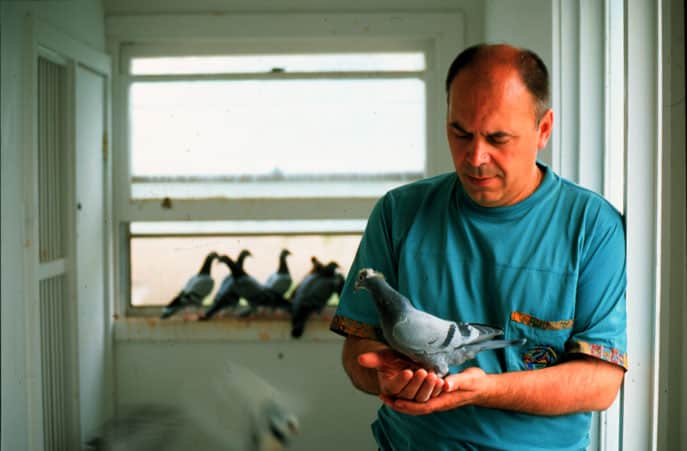
| The bond between man and bird is very apparent in this photo
of Andrew Skrobot in one of his young bird holding lofts in
northern New Brunswick. We should all have this deep affection
and bond with our birds but it really is much more rare today
than in the past. Andrew’s birds love spending time with
him and I dare say that Andrew certainly loves spending time
with his birds. Close observation and trust and infinite patience
is the key to great pictures. |
|
| Figure 2 Andrew and youngsters. |
Here is what he had to say to me during a recent visit, "My interest in technology led me to my passion
of photography using a digital camera.
Rendering these digital images was an expected consequence. This
interest eventually led me to introducing a graphic arts program at the
high school that I taught for 3 years.
Being a pigeon fancier it was only natural that my favorite subject
would become the racing pigeon." I guess it really would be safe to
say that you were really ahead of the curve and saw the writing on the
wall as regards the direction that standard photography was then going?
Andrew
continued to say, "One of my
responsibilities as vice principal of Bathurst High School was overseeing the production of the yearbook.
I convinced a teacher who was very technologically literate that
we should do it all digitally. At that point photographs were taken using a
35 mm camera and the layouts were done cutting and pasting photographs
on a sheet of paper and then this hardcopy was sent to the publisher. We worked as a team. My responsibility was to take all the homeroom,
sports and other group pictures and render them for the yearbook.
Her responsibility was to do the design work and create the layout
using QuarkXpress. We were one of the first if not the first high
school in the province to produce a year book that was sent to the publisher
completely in digital format. I
proudly can say that our yearbook became the standard for yearbooks in
the province. I looked through
many high school and university yearbooks and could not find better photographs. Even the professional photographer who had doubts
that I could do it was very impressed."
Now the key to great photography is complicated, it
requires many elements and in our 21st century these elements
no longer include the "cut and paste" method, though great at one time
it is obsolete today. Great pictures of racing and fancy pigeons require
hardware ( excellent digital camera, high end powerful graphics computer) excellent software (including Quark and Photoshop) but
in addition to these and even more important it requires the love of,
understanding of, the patience for pigeons and how they should ideally
look. To this end here is what our Canadian specialty pigeon photographer
has to say, "In conclusion I must say that I enjoy all
facets of the sport. However, my
greatest satisfaction comes from photographing racing pigeons and rendering
the photographs to make the bird look the best it can be. My goal is to become the best at this."
In
the past I have paid for the best, have never quibbled about price and
I carted my birds to different basements, halls, combine events and waited
in line for my turn to have my pigeons photographed. Thankfully from now
on this will no longer be the case. Our own Canadian from Northern
New Brunswick Andrew Skrobot
has proven to me that he has what it takes to be the "very best photographer" in the world. I was so intrigued with his
abilities that I arranged to have him come to Port Perry to photograph
virtually every bird that I have. I am sure that I could have gotten the
more famous Europeans to visit and photograph my birds but I am equally
certain that I could not have gotten a more exceptional body of work from
anyone in the world. To this end I have included a wide range of the photos
taken by Andrew Skrobot in this article.
Who knows I am so impressed with Andrews work that one day we may work
on producing another "World Champions" book together!
 |
| Andrew must have known that I was
a great “Eye sign” man so he sent me a photo of
my “Braveheart” CU 2002- 15156 stressing the eye
and its details. His composition certainly makes for a very
interesting photographic image. Andrew I Think that you may
have confused me with some of your other clients, remember I
am the guy who was on the other side of the “eye sign”
debate and had “eye sign” discussions raging in
every club house in America for almost a year! |
|
|
Figure3 Knowing how keen
I am on eye sign here is one of the first pictures I saw Andrew
do of my "Braveheart" note the unique composition plus
the incredible confirmation of the pigeon. Shots of this quality
take great patience and dedication. Look closely at the feet of
every picture in this article, you will notice that the feet are
all there, not cropped or cut badly as I have so often seen.
|
|
|
| Figure 4 Final Picture of "Braveheart"
before he was exported to Taiwan.
Note the stance, the clarity of color and the detailed overall composition
of this photo. The background is most appropriate as it is the New
Brunswick wilderness that "Braveheart "flew
seven races over. This is the type of image I believe you are entitled
to and should get when you pay a professional to take a photo of your
Champion. |
|
|
| Figure5 Who wouldn't
fall in love with this exceptional hen purchased by Andrew
Skrobot at the 2002 Alberta
Classic and bred by Silvio Mattacchione.
Look closely at the detail and the color rendition, the confirmation
and stance have been captured and the photo actually speaks to you
of the inner qualities an intensely inbred Spanjaards
hen. |
The preparation
of images or photographs for book printing using the photolithographic
method is quite different from the preparation of photos for printing
on color printers. Essentially if you are going to be taking photos for
eventual use in a book please note these observations that we advise all
of our clients of. These observations will end up saving you time, effort,
and ultimately a lot of money.
| If you are submitting digital images on disk please
note the following requirements:
TIF ONLY
All photo images must be prepared as TIF files only please - do
not submit anything other than TIF! Make especially sure that they
have been scanned appropriately as regards the highlight and shadow
areas (generally, a 3% dot in the Highlight [light] areas of the
photo and 90% dot in the Shadow [dark] areas of the photo). Without
the appropriate values being adhered to, you will fail to achieve
the image quality and color quality that we desire!
For color reproduction, photos
must be 300 dpi at the actual size that they are intended to be
printed in the book and saved in CMYK format (not RGB). For example
if the introduction has a color photo that is 6 inches tall, then
at 6 inches tall, the image must be 300 dpi. This also applies to
black and white photos. Low dpi will result in poor printed picture
quality.
For line drawings we require 600
dpi at actual printed size.
The ‘dpi’ (dots per square inch)
rating allows us to print at a particular line screen. Therefore,
if the printer uses 150 line screen the minimum dpi must be 300
DPI. If the printer uses 175 line screen, then the minimum dpi must
be 350 dpi. Etc.
|
Now the above referenced details are applicable only
if you are working on creating books, literature, packaging and all other
like materials of high quality. When you are preparing photos for use
on the internet, for pedigree programs and for output great photos to
be framed and hung, a slightly different set of specifications apply because
in fact it is a different process.
So
what we need are in fact are hard earned trade secrets. Well Andrew can
you in 50 words or less give me all of your secrets, all of your little
hints (boy talk about asking for the moon)? Bingo, add generous and humanitarian
to great photographer, Andrew was more than happy to share his hard learned
know how!
Here is what he had to say: "
"I am trying to make the instructions
as simple as possible. But these are some of the area where most people
have difficulty with if they do not understand resolution."
ANDREW
CAN I TAKE MY OWN PHOTO AND SEND IT TO YOU TO WORK YOUR MAGIC ON?
Dear
reader I knew you would ask this question so I posed it for you in advance.
Andrew Skrobot is actually preparing a special section on his web
site for your education and convenience. You can take your own photos
and email the jpegs to Andrew directly and he will work magic for you
(and all at a reasonable cost that is very competitive with the regular
prices from the European photographers). So whether you are in Alaska or Taipei, Bangkok or Toronto, Durban of Rome, Grave or Chicago, St. Augustine or the North Pole Andrew will be able to help you
present your pigeons in the best possible fashion. Sounds too good to
be true well take a look at these before and after photos. All sent by
email!
|
|
| Figure 6This is the before photo taken by
a fancier in British Columbia and emailed to Andrew
Skrobot of Bathurst, New Brunswick to see how he
could enhance it. The color of this bird is washed out looking, its
feet are dirty and it is also molting. All in just a really average
photo. Also note the droppings. This is not how you want to remember
your Champion. Remember all done by email. |
|
|
| Figure7 This is the After photo. This is the same pigeon above illustrated
but after it has had its feet cleaned up, droppings removed, color
rebalanced, image sharpened. Design and compositional elements added.
Remember all this is done by email at the same cost as you would expect
to pay from a photographer who comes in from Europe.
This is a truly incredible service that is now being offered by the
exceptional Canadian photographer Andrew Skrobot. |
Andrew
Skrobot
advises that you can make use of this unique service by forwarding to
him jpegs to eskroban@nbnet.nb.ca
and you can visit Andrew at his internet site at
http://www.tourdesmaritimes.com/Photography/Photography.htm
Well
how about an instant replay of this before and after miracle. This time
a checker hen heavy in the molt, yet you have no time to waste waiting
for it to molt out because you have a buyer in Japan who really wants
to see a great photo now. There is a lot of money at stake so what do
I do. Well do what I am doing just call Andrew and mail him your average
photo! Then sit back and watch the magic of our new digital world happen.
Remember that
all photos should be forwarded in jpeg format and around 1 Meg size.
|
|
| Figure 8 THE BEFORE photo is not very impressive
this pigeon has campaigned hard. It is heavy into the molt, its feathers
in this photo look washed out. Generally you know that this photo
will not inspire or thrill your Japanese buyer or anyone else for
that matter. It's not the bird's fault it's just the wrong time of
year. What do I do now? |
|
|
| Figure 9 The AFTER photo. You can see that we have carefully taken this
checker through the molt, cleaned her feathering, and sharpened her
color. This is exactly the way this pigeon would look after her molt
if the picture was taken by an expert photographer
. Andrew Skrobot has done
an exceptional job. |
I
look at these before and after photos and am blown away at what can now
be done by photographers like Andrew
Skrobot. His email "BEFORE AND AFTERT"
email photographic service is unique a "MADE IN CANADA
FIRST"!
SETTINGS
"When photographing birds I always
assume that I will use the photograph eventually for printing a hard copy
so I set the camera at the highest resolution possible. This setting on
most cameras is called "fine".
Digital cameras have other settings
called normal and basic. These lower settings limit print size because
there are not enough pixels for a high-resolution picture."
|
|
| Figure 10 I think that you will agree that
these photos are of exceptional quality. Andrew Skrobot
really has a way of bringing out the inner qualities of exceptional
pigeons. You do not have to be a recognized Champion to have an exceptional
photo taken of your favorite birds. |
PHOTOGRAPH SIZE
"For example using the fine setting the photograph
size will be for a:
4 megapixel camera - 2200 x 1700 pixels (28" x
21") at 72 dpi
3 megapixel camera - 2048 x 1536 pixels (32 x 24")
at 72 dpi
Both 3 & 4 megapixel camera will print an excellent
8 x 10 photo after resizing. A 2 megapixel camera will produce a good
5 x 7 photo for printing. All these cameras will take excellent pictures
for the internet."
|
|
| Figure 11 Bill "pumpkin" Madore
of Glace Bay had Andrew Skrobot
photograph his long distance champion "Hurricane". He has
won several long distance races from Quebec City
to Glace Bay, Cape
Breton. Andrew
Skrobot has again captured the character and determination
of this great Canadian Long Distance Champion. |
RESIZED
"When resized to an 8 x 10 the 4 megapixel photo will
have a resolution of 225 dpi and a 3 megapixel photo will have a resolution
of 205 dpi. Normally the higher the resolution the better the quality
of the picture. Kodak recommends a resolution of 225. However, for the
internet photos are always at a resolution of 72 dpi.
The lowest setting "basic" is used mainly
for emailing photos that will only be viewed on the monitor.
Do not resize a digital photo larger. This will affect
the quality of the picture. Some enlarging (10 to 20%) can be done, but
I will do that if necessary."
SCANNING
"If scanning a photo follow these steps. Set the scanner
at a minimum resolution of 225 and set the dimensions to the size required.
Select the bird - remember you are scanning the bird not the picture."
ANDREWS TIPS
FOR PHOTOGRAPHING BIRDS
Camera
settings
- Most modern digital cameras have an excellent
automatic mode that will automatically adjust to the conditions. I normally
set the flash to go off all the time.
|
|
| Figure 12 The breeders of this exceptional pigeon are the well known
team of Radoman/V. Jagt's. I am sure that they will hang this photo
with great pride an exceptional pigeon photographed by an exceptional
photographer. |
Preparing
the bird
1.
Wash the feet
of all debris. Washing the legs and feet will make them redder. Clean
the toenails and beak. If any feathers are dirty clean them off with a
wet rag and then put the bird in the basket for 30 minutes to settle it
down. Some birds hate to get their feet washed and will struggle in your
hand therefore ruffling the feathers. Photos taken in the winter (December
& later in my area) when the birds are completely molted out produce
the best pictures.
2.
Before putting
the bird in the photo box, hold the bird in your hand for a few minutes.
While doing so stroke the bird towards the back gently. This will calm
the bird and reposition the body feathers to lay firmly against the body.
Make sure the cover feathers on the shoulder are arranged correctly. Nervous
birds often struggle in the hand and their feathers will often be out
of place or ruffled.
3.
When placing the
bird in the photo box consider which way you want the bird facing for
the photo. Photos can be flipped horizontally but it will make the band
appear on the opposite foot and the band numbers will be inverted like
on the hood of an ambulance. However
this is usually not noticed and of no major consequence to the picture.
Often
times we have very old photos in our files of great old champions can
we do anything with these old timers Andrew? I think you will agree that
as they say a before and after photo is worth a thousand words! Take a
good look at what was done to this old image.
|
|
| Figure 13 this is a BEFORE Photo an old
and a very important Foundation pair that belonged to Tom Mackowecki
purchased by him from Jules Gallez. Andrew describes how the certificates
were a real challenge! |
|
|
| Figure 14 After Photo notice the certificates,
the new background the sharpened color of the birds as well as the
feathering. An important old photo made new again by photographer
Andrew Skrobot. |
Taking the photo
1)
I use a photo
box that measures 16" x 24" x 16". A nest box will do fine. A spotlight would be
useful but not necessary. I use
two 60 watt bulbs fastened to the top front of the photo box. A tripod is also recommended but not necessary.
2)
Remember "patience is a virtue" - you will
need it. Taking a good photo is all about "profile". The bird
should face to the right or left and be perpendicular to the camera. Some
birds are naturally photogenic and will give you the perfect profile.
Most will have to be prodded into position.
An 18" dowel is very useful for this purpose. Before shooting
these are some things to look for.
|
|
| Figure 15 Named after a wild New
Brunswick river "Restigouche
red" is one of Andrew Skrobot's
foundation sires. |
a)
Camera should be perpendicular to the upper shoulder
of the bird. I shoot from a distance
of about 18". Turn all lights off
behind you. The darker behind you
the better because the bird will tend not to want to leave the box.
b)
Use the monitor on the camera and zoom in or move in
to the point where the bird fills most of the monitor.
c)
When placing the bird in the box make sure that the
wing tips are sitting on the tail. The
first thing the birds will do is leave a dropping. It is advisable to pick it up because most of
the time they will eventually step in it.
d)
Both feet should be side by side and the tail slightly
down.
e)
The bird should be facing to the right or left and
standing in a fairly upright position.
Using the dowel coax the bird in to position. By stroking the bird under the beak and gently
lifting the head will help. Most
birds hate this procedure and will shake their head when touched with
the dowel.
f)
Click
away. Usually it will take several
photos before you get the right one.
|
|
| Figure 16 "Silverado" is a super
late bred cock , bred by Andrew
Skrobot ,that bred the 2nd place overall winner in
the "2003 Le Tour " series in New Brunswick. |
Once
again, I remind you that "patience is a virtue".
You will need it.
Quite often we would like to give our pigeon friend's
unique and often funny pictures that show how much we care for their friendship
so if this is ever the case Andrew Skrobot
can also help you as this example shows so clearly.
A long time friend and fellow teacher of Andrew who taught motor
mechanics got this photo when he retired.
|
|
| Figure 17 Great gift idea
for your pigeon friends. This is just one example of what Andrew
Skrobot can do in this area. |
|
|
| Figure 18 A beautiful hen
purchased at the Le Tour auction on Dr. Franks site at the Alberta
Classic. |
I have many, many more photos that I could use to further
describe the photographic talent of this exceptional pigeon photographer
but I think you get the picture. You can email Andrew Skrobot directly to take advantage of his unique email photo service by forwarding to
him jpegs to eskroban@nbnet.nb.ca and you can visit Andrew at his internet
site at http://www.tourdesmaritimes.com/Photography/Photography.htm
.It is also
very important to note that when Andrew Skrobot takes your photos for you he gives you several full
color hard copies as follows: 1-
8 X 10 inch , 6 - 4X 6 inch plus you get all of the images on a permanent
CD with the images optimized for your web site, or you can take the supplied
disk to a local photo processor who can then make you as many hard copies
as you may wish. All in all a truly great service for
only $30.00 US or $45.00 Canadian. If you are having an event you
might want to contact him to be there as your events official photographer
.Either way for my money I will no longer be using imported
photographic talent but will support our
very own "Made in Canada Pigeon
Photographer" Mr. Andrew
Skrobot.
I invite all North Americans to do the same after all nothing is more
important than quality, service and price and in all of these categories
Andrew Skrobot for my money is ahead of the pack! No bout you are
all asking who won the "2003 Le Tour" series race well here is the photo
of the Champion taken by Andrew!
|
|
| Figure 19 Great bird entered by Pat Spelliscy
,who deserved his fine win at Le Tour 2003 as of this writing
the auction has not yet closed so it is not known who will rescue
this pigeon and take it home as a potential future Champion. Good
luck to all you bidders. |
Yes I can hear
you all now complaining that I have avoided the most necessary of all
items and that is the "EYE SIGN PHOTOS"? Well here we go photographing
the eye made easy now by Andrew Skrobot!
PHOTOGRAPHING
THE EYE
How did you learn to photograph the eye?
I have learned how to photograph the eye by a lot of experimentation and
a lot of trial and error. Some would call it guess and test.
In my case it is a lot of guessing, testing and mostly error.
Did you experiment with many different cameras?
I have experimented with several digital cameras since 1998. First,
I began using a Kodak 290 with no macro mode and had to buy close-up lenses
for it. Shortly after I tried an Olympus 3030
Zoom with a macro mode but the macro mode would only allow photos to be
taken from 8" (20 cm) and didn't result in good close-up shots.
Finally I got an Nikon Coolpix
880 to experiment with. With this camera the macro mode works within
4 cm of the object. Just recently I was fortunate to obtain a Nikon
Coolpix 995 with a macro mode that allows taking photographs
from as close as 2 cm. I have found that this close is not practical
in photographing the pigeon eye because the sunlight is blocked out.
A distance of around 5 cm and zooming in slightly is advisable.
The Nikon Coolpix 995 is considered to be one
of the best macro mode digital cameras available. My experience
suggests this to be true. Just recently I have purchased a Coolpix 4500 and basically the only difference is that it
is a 4 mega pixel camera.
What are the ideal conditions for taking the great eye photos?
In the beginning, all photographs were taken in strong sunlight around 12:00 pm.
I found that under these conditions the pupil constricts the most and
allows you to see the circle of correlation in its fullest detail.
The photo at bottom of this page was taken on Feb 17 with the Nikon 995
when the sun is still low in the sky. These are not ideal conditions.
Summer photos with a high sun seem to come out better.
Any real problems that you encountered?
There is a problem of taken photos in strong sunlight because the camera
picks up the suns reflection in the pupil, circle of correlation and iris.
This is especially true for birds with darker eyes. The yellow eyes
seem to photograph best. I experimented with polarizing filter with
no success.
Waiting for the ideal sunny conditions
can be one of the most frustrating aspects of photographing the eye.
Unfortunately I don't live in sunny Alberta.
During the winter of 2003 I experimented with several artificial light
sources and found that a 90 watt Halogen spot light worked the best.
It was fixed about 6 to 8 inches away from the eye and at about 45 degrees
horizontally and vertically from the eye. A swivel lamp with a clamp
is ideal for this purpose. The disadvantage of using a Halogen lamp
is the heat it gives off. Be careful not to hold the birds
eye too long under the light. Also by covering the left side of
the camera with aluminum foil it will protect
the camera from overheating. The light should be turned off when
not needed. The advantage of this light is it seems to give the
truest eye color and very few adjustments have to be made. And it
is strong enough to constrict the pupil therefore showing the details
in the eye much better. Usually the photos of eye come out a little
darker than the normal eye color but this can be adjusted easily.
Another disadvantage is the reflection from the bulb. By manipulating
the lamp the reflection will only appear in the upper left hand corner
and not interfere with the most important parts of the eye. Aesthetically
this is not ideal however the lamp allows you to take photos whenever
it suits you and quickly. And before I forget,
the darker eyes have considerable less glare.
Andrew is there any other options for a light source?
There is another option for a light source. It is a circular lamp
designed specifically for macro photography using most Nikon Coolpix cameras up to the 4500. From what I have heard
and seen this lamp leaves many reflection spots on the eye therefore it
is not suitable.
Necessity is the "Mother of Invention"!
This is the device that I use to assist me photographing pigeon eyes.
It allows me to hold the bird's head still when the shot is taken.
The original one was designed for the Nikon
880 and was not suited for the Nikon 995 because it has completely different
case. I made some minor modification to it so that I could use it
on the 995. It is quite a primitive prototype but satisfies a need.
The frame was made from a piece of aluminum siding and I used duct tape
to cover the sharp edges. The slots allow the fastening bolt on
the tripod to screw into the camera. This device was used on 4 different
cameras that is why the slot is in an "L"
shape.
|
|
| The Skrobot device indicates clearly how problems
give rise to opportunities. I believe in the old KISS adage (
keep it simple stupid) |
The following pictures show several views of the camera mounted on a tripod
with this device.
|
|
|
| The photos below show how to hold the bird's head
against the device. It assists by holding the birds head stationary
for focusing. Unfortunately this device only allows photographing
the left eye. I am working on some modifications to this prototype
that will allow photographing both eyes much more easily. Before
I forget, the sun should come over your left shoulder, otherwise this
camera blocks out the sun. Use the camera monitor to compose
the photo. Also you will need an assistant to do the shooting
as whoever holds the bird will have both hands occupied. |
Its easy once someone shows you how?
|
|
|
|
After the photos are taken they are download to
the computer.
|
Do you use a graphics program?
Using a graphics program like Adobe Photoshop minor adjustments are made
to the color, brightness and sharpness to make the photos as realistic
as possible. For viewing on a computer monitor a size of 5"
x 5" (12 cm x 12 cm) is preferable. I have
used photos up to 9" x 9" with
success. The resolution of these photos always must be a 72 pixel/in
or 28 pixels/cm for the web. Also the file size for these photos
should not exceed 50 kb in size for quickness in loading on the web or
receiving by e-mail. The latest version of Adobe Photoshop versions
5, 6 & 7 optimize photographic files just for this purpose.
Another program which is considerable less expensive and useful is PaintShop
Pro. The last 2 versions, 6 & 7 also optimize photos for the
web.
 |
| “In conclusion I must say
that I enjoy all facets of the sport. However, my greatest satisfaction
comes from photographing racing pigeons and rendering the photographs
to make the bird look the best it can be. My goal is to become
the best at this.” |
|
|
Figure 20
ANDREW SKROBOT
EDUCATOR
/PHOTOGRAPHER/PIGEON FANCIER.
|
Racing Pigeons Section Contents
Ashdon Farms
Background on Silvio Mattacchione, his pigeons, his loft,
and inbreeding program.
Articles
A group of articles and editorials addressing various aspects
of the sport of pigeon racing and the history of Silvio's line of Spanjaards/Janssens
pigeons.
Pigeon Books
Buy fantastic pigeon books online! Selections include The
Will to Prepare by Robert Kinney, Rotondo on Racing Pigeons
by Joseph Rotondo, and The Pigeon Guide by Dr. Jon Esposito and
Shannon Hiatt.
Pigeons For Sale
Some of Silvio Mattacchione's own winning stock is for
sale.
Pigeon Consulting
Sivio
Mattacchione offers a wide range of racing pigeon consulting services
and consults with owners as far away as Australia, Mexico, Taiwan, The
Philippines and the United States. Each consultation is tailored specifically
to meet the client's needs, and is conducted in as thorough a manner as
possible.
Charity Events
Good causes supported by Silvio and the racing pigeon and
parrot communities.
Emoticons
Clever pigeon pictures constructed of keyboard strokes
by artist Jerry Downs.
Pigeon Links
Links to other racing pigeon sites including those of clubs,
products, and information resources.
An easy way to navigate a series of pigeon web sites!
Contact Us
Silvio's e-mail, mail, phone, and fax contact information.
|